


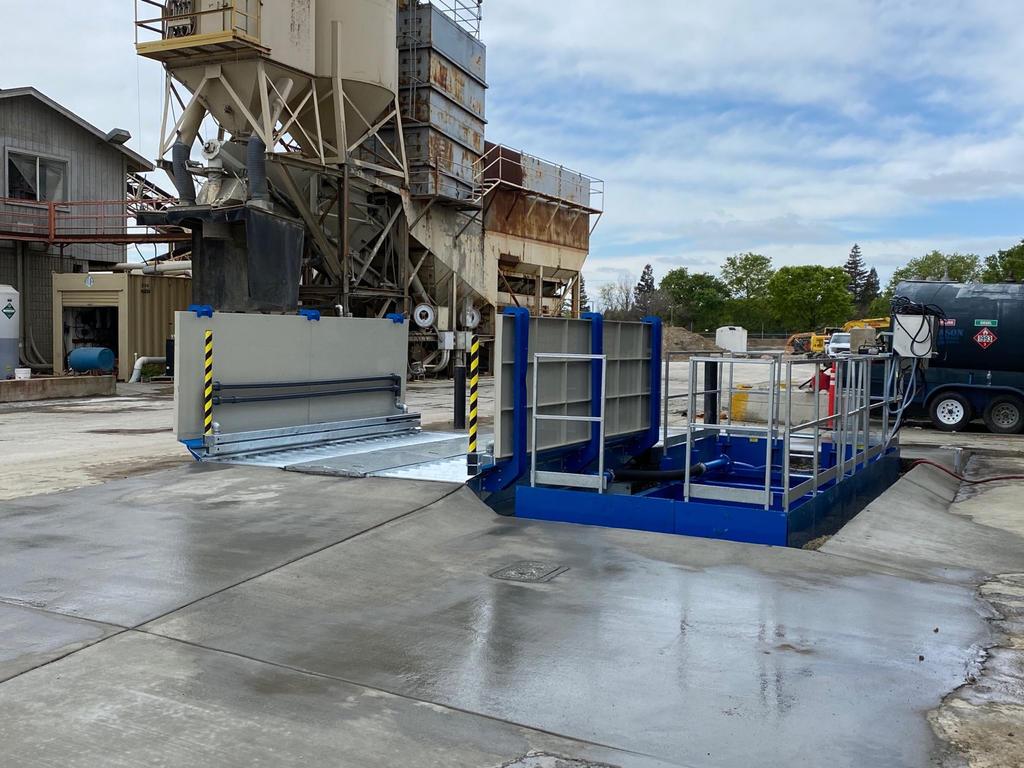

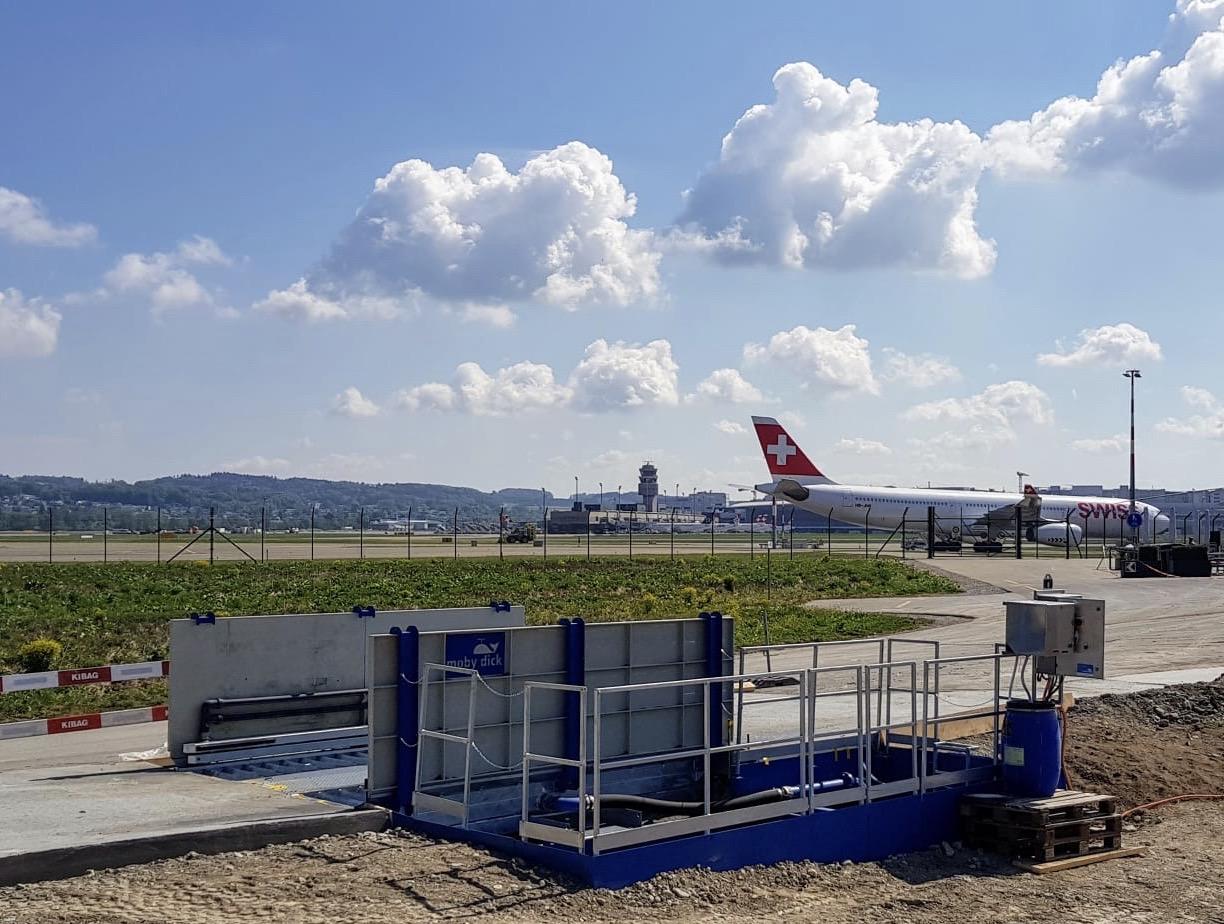


Technical data
- Length of the wash unit: 400/600/800 cm
- Clear drive through width of the wash unit: 280/345 cm
- Maximum axle load: 15 t
- Height of splash walls: 136 cm
- Nozzles (min. 7 mm core diameter): 130-260 kos
- Nozzle bars per side: 2
- Recycling tank volume: 50/100 m3
- Service water useful volume: 35/70 m3
- Clarifying area recycling tank: 25,5/51 m2
- Maximum pump power: 2,5/10 m3/min
- Connected load of the entire system: 11,2-22,4 kW
- Acoustic emission: <75 dB
Technology
Wheel Washing
Tire wash systems – The tire wash systems consist of the actual washing technology on the one hand and water recycling on the other. The more effective the washing technology, the more dirt has to be separated from the water during water recycling. The washing technology and water recycling are therefore closely linked. Only the right coordination of the two areas leads to a solution to the problem which is adapted to the requirements of the customer in terms of budget and function.
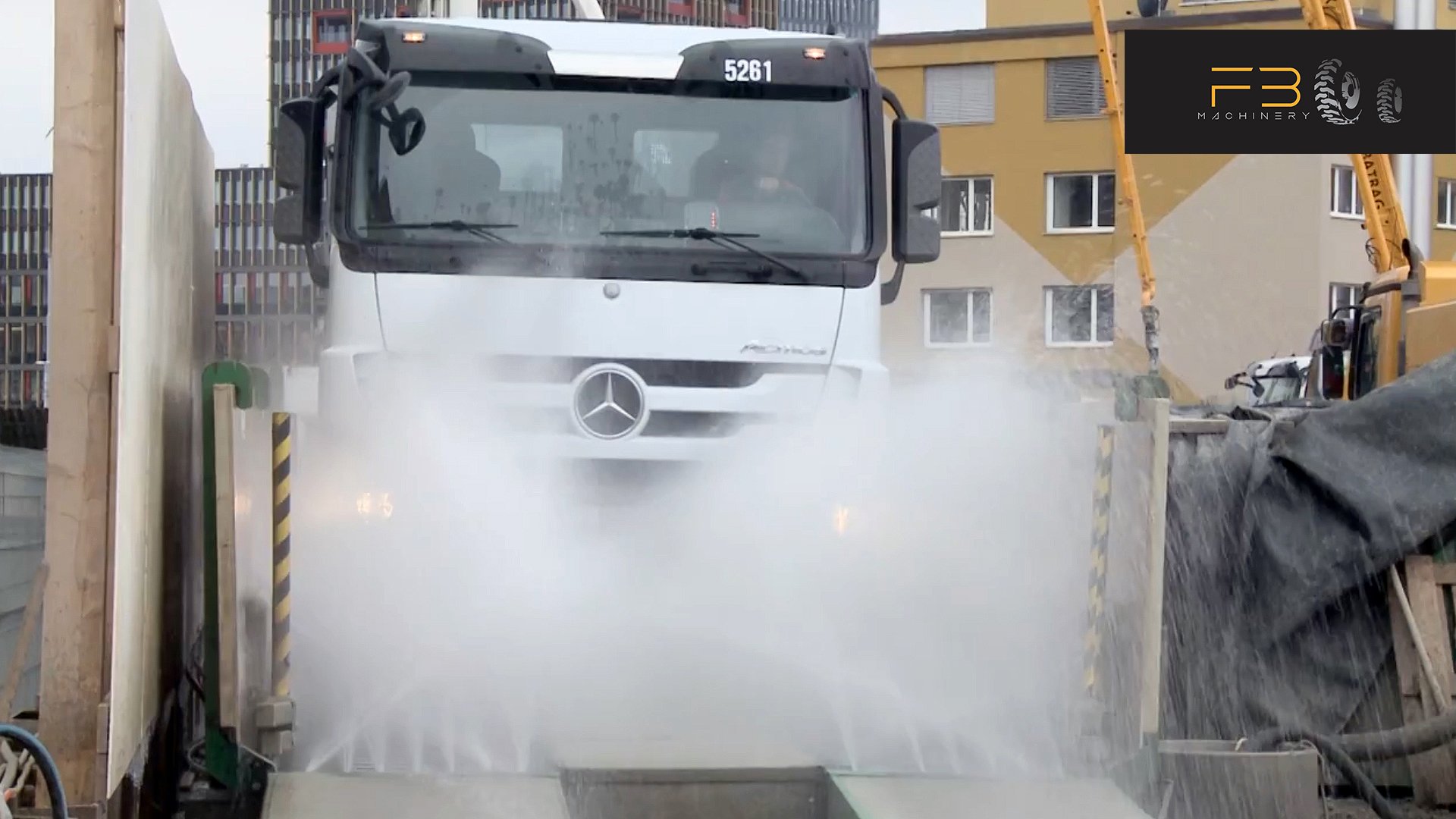
Washing technologyScientific test arrangements with very different water pressures, different nozzle shapes and nozzle diameters, as well as different angles of incidence of the water jets, have proven that a large volume of water at low pressure leads to the best results. Of course, a large volume of water under high pressure is even more effective. This would, however, increase the energy consumption exponentially with relatively little additional benefit..
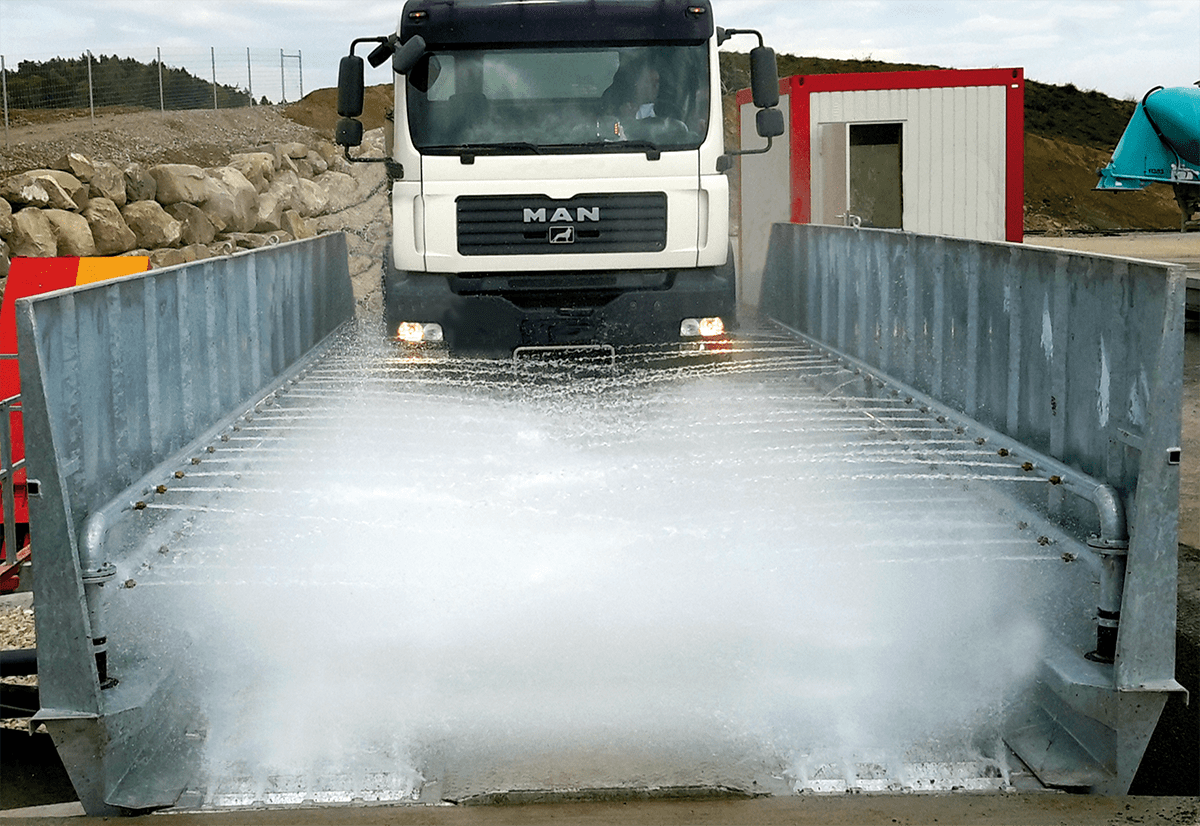
A strong jet (minimum 6 mm diameter) at low pressure (the jet does not change its direction between the nozzle outlet and point of impact on the tires or chassis) produces the best result. In contrast to a thin, high-pressure jet, it does not lose its energy due to the air resistance and can transport the kinetic energy fully to the point of impact. To achieve this result, the MobyDick special “MobyPump” immersion pumps developed by FRUTIGER are used in the Moby Dick wheel washing system. Connected in series, they keep the starting current low.
Advantages of the principle “High water volume, low pressure”:
- The nozzles can be sufficiently dimensioned to prevent clogging.
- Immersion pumps can be used, which has great advantages during winter operation.
- The water has not only the function of washing the vehicle, but also of rinsing away the washed-off dirt, stones and clumps of soil out of the system and into the water recycling. Large volumes of water are essential for an automatic cleaning of the washing area.
- The MobyDick wheel-washing systems spray where the spray is desired. The spray pattern is kept low for the tire wash. The upper chassis, the windshield and, in particular, the rear-view mirrors remain dry.
Water recyclingOur robust immersion pumps do not place high demands on water quality. Even slightly cloudy water is sufficient to achieve the desired cleaning effect. The objective is a clean road and not a shiny vehicle! To achieve a satisfactory water quality, we use intelligent, combined recycling tanks with baffle walls and overflows. After a washing process, the water is treated in these tanks through sedimentation.
The tanks can be adapted to the specific customer’s needs in terms of available space and the desired method of sludge removal (e.g. via a chain conveyor). As a rule, we refrain from the use of additional equipment to separate mud and water, such as inclined plate clarifiers or cyclones, as these bring major disadvantages for this type of application (acquisition costs, maintenance costs, winter operation, sludge clearance, etc.).
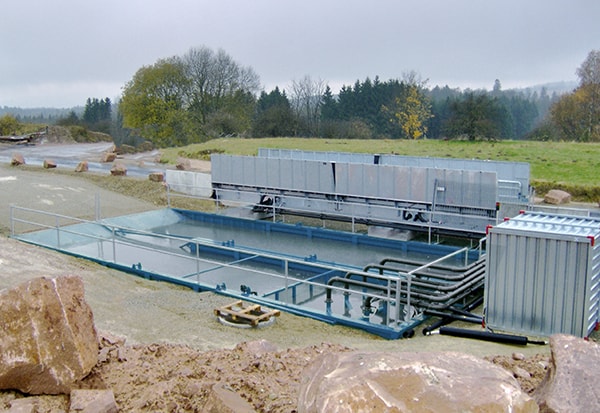
Manual debris removal with the wheel loader
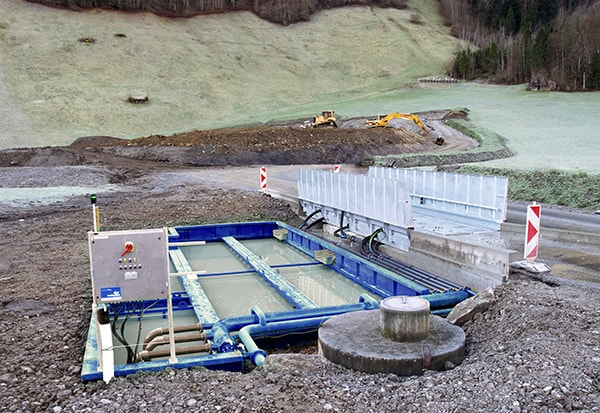
Manual debris removal with the excavator
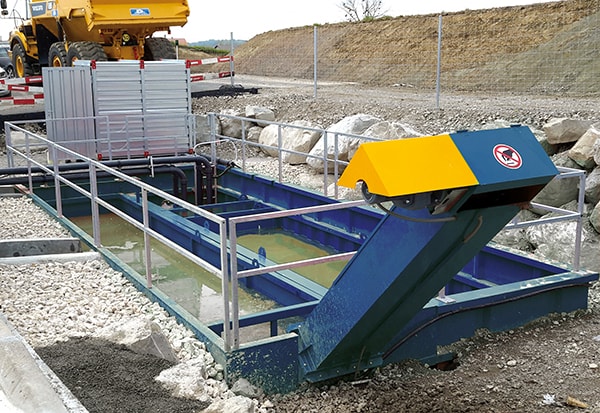
Semi-automatic debris removal
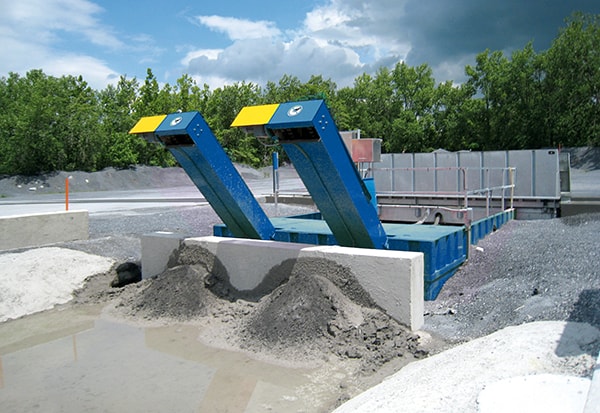
Fully automatic debris removal

